


The West Texas Farm Tire Guide: What Cotton Country Demands
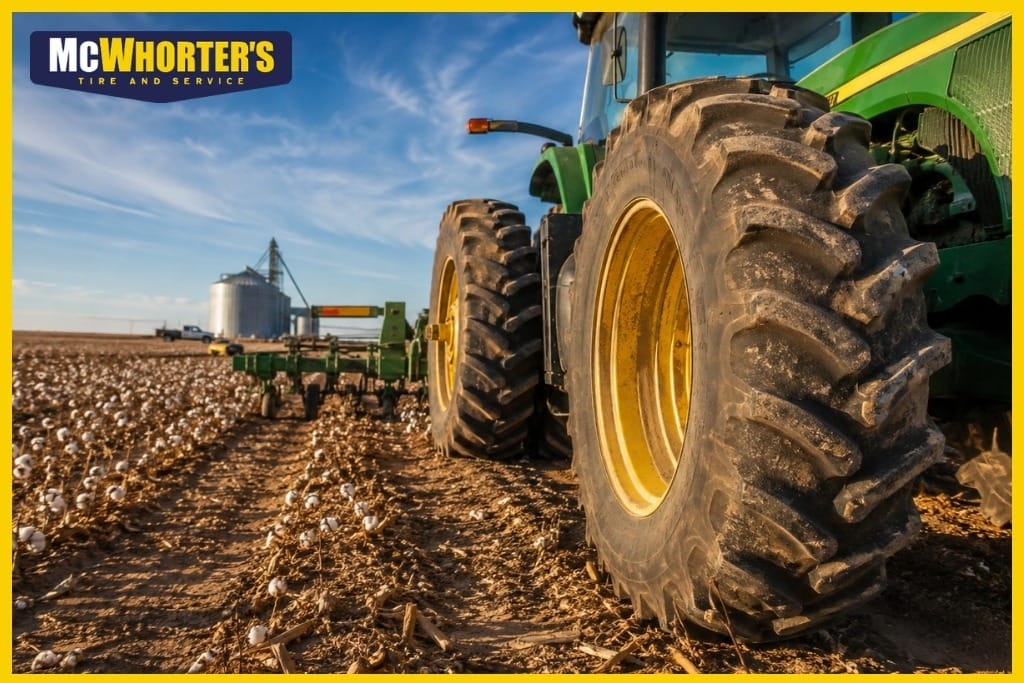
Out here, choosing a farm tire isn’t just about tread life. It is about your soil, your fuel bill, and whether your equipment is running when you need it most.
Ask any farmer on the South Plains what a blown tractor tire costs in the middle of harvest, and you won’t get a dollar figure for the tire. You will hear about the hours lost, the narrow weather window closing, and the crop sitting while everyone within fifty miles seems to need service at the same time.
Farm tires in West Texas carry heavy loads across soft fields, travel long distances between scattered acreage, and take a beating from extreme heat, caliche roads, cotton stubble, and rough field edges. The right tire setup helps protect your ground and your uptime. The wrong one can cost you in ways that do not become obvious until later.
At our tire shop, we see these conditions firsthand across Lubbock and West Texas. This guide breaks down the tire decisions that matter most before your equipment heads back into the field.
Why Tire Choice Matters More on West Texas Farms
Farming the South Plains isn’t like farming in wetter, more compact agricultural regions. Fields are large and spread apart. Equipment can cover real distance between one property and the next, often traveling over caliche access roads or pavement before returning to the field.
The equipment itself can also carry substantial weight, particularly during harvest.
That combination asks a lot from a farm tire:
- Flotation: The tire needs to spread the machine’s weight across a larger area so equipment can move across soft or irrigated ground without excessive sinking.
- Traction: The tire needs enough grip to transfer power efficiently without excessive wheel slip, which wastes fuel and disturbs the soil.
- Durability: Caliche, field debris, cotton stubble, and repeated road travel can be hard on tread and sidewalls.
- Load capacity: Tractors, harvesters, implements, and other equipment need tires matched to the loads they actually carry.
- Heat management: Long operating hours and West Texas temperatures add heat stress, particularly when equipment travels between fields.
Farm tire selection therefore affects much more than traction. It can influence fuel use, tire life, equipment performance, soil conditions, and the overall productivity of the operation.
Soil Compaction: The Hidden Tire Cost That Can Affect Yield
Soil compaction is easy to overlook because the consequences may not appear immediately.
When heavy tractors and harvesters repeatedly travel across a field, the weight can compress the soil beneath them. Compacted soil has less space for air and water, which can restrict root development and reduce water infiltration.
Repeated traffic over the same rows can make the problem worse over time.
This is where the tire footprint becomes important.
A larger footprint spreads the machine’s weight across a greater surface area. Depending on the equipment and application, that can be achieved through:
- Appropriate inflation pressure
- Wider tire sizes
- Dual tire setups
- Additional axles
- IF or VF tire technology
Where IF and VF Farm Tires Fit In
Two terms you may see when shopping for modern radial farm tires are IF and VF.
- Increased Flexion tires (IF): These use a more flexible casing than conventional radial farm tires. They can typically carry more load at a given inflation pressure, or comparable loads at a lower pressure, when used within manufacturer specifications.
- Very High Flexion tires (VF): These provide even more casing flexibility, allowing comparable loads to be carried at lower pressures, or greater loads at comparable pressures, depending on the tire and operating conditions.
Why does that matter?
Lower operating pressure, when appropriate for the tire, load, speed, and application, can create a larger footprint. That can improve flotation and help reduce surface compaction while still supporting the weight modern farm equipment carries.
The important part is not simply buying an IF or VF tire and lowering the PSI. Inflation needs to match the actual equipment, axle load, travel speed, and tire manufacturer’s recommendations.
Pro Tip: Soil compaction may not become obvious immediately. Pay attention to tire pressure and equipment weight before repeated passes create a problem that follows the field into future seasons.
The Field vs. Road Tradeoff on the South Plains
Here is a challenge that matters particularly on spread-out West Texas operations: your equipment doesn’t stay in one field.
Tractors and other machinery may travel miles between properties on caliche roads and pavement. That means the same tire has to perform in two very different environments.
In the Field
A properly selected lower inflation pressure can provide:
- A larger footprint across soft soil
- Better flotation
- Improved traction
- Less surface compaction
During Road Travel
Extended road travel changes the demands on the tire. Speed, load, tire flex, and internal heat buildup become increasingly important.
Inflation should be matched to:
- Actual axle load
- Travel speed
- Tire construction
- Manufacturer recommendations
A pressure that works well in the field may not be appropriate for a long road trip. Likewise, a setup optimized for road travel may not provide the footprint and traction you want when you enter softer ground.
Managing the Field and Road Difference
There are several ways to handle that tradeoff:
- Check pressure for the job: Do not assume one PSI setting is correct for every field, load, and road condition.
- Adjust when necessary: Equipment that regularly switches between long road stretches and field work may require pressure adjustments based on tire guidance.
- Consider central tire inflation systems: On compatible equipment, CTIS technology allows operators to adjust tire pressure as operating conditions change.
- Use load and inflation tables: Tire appearance alone cannot tell you whether pressure is correct. Manufacturer load and inflation information provides a much better starting point.
Surviving the West Texas Cotton Harvest Window
Cotton harvest doesn’t wait.
When conditions are right, everyone is running. That is exactly why a tire failure in the middle of harvest hurts so much.
It isn’t just the replacement tire. It is:
- A harvester or tractor sitting idle
- Crew time being lost
- Favorable harvesting conditions slipping away
- Service demand peaking across the area at the same time
The solution is boring and effective: inspect harvest equipment before the season, not during it.
Before the machines head into the field, check:
- Cold inflation pressure: Make sure it matches the tire, load, and equipment requirements.
- Sidewalls: Look for cracking, cuts, bulges, weathering, or damage from previous seasons.
- Tread and lugs: Check for deep cuts, chunking, unusual wear, and embedded debris.
- Valve stems and bead areas: Watch for damage or signs of slow air loss.
- Known problem tires: If a tire was losing pressure or showing damage last season, harvest is not the time to see how much longer it will last.
Pro Tip: Inspect harvest equipment tires well before the season starts, not when the machine is ready to work and the forecast is changing. Problems are much easier to solve when you still have time.
West Texas Field Hazards That Chew Up Farm Tires
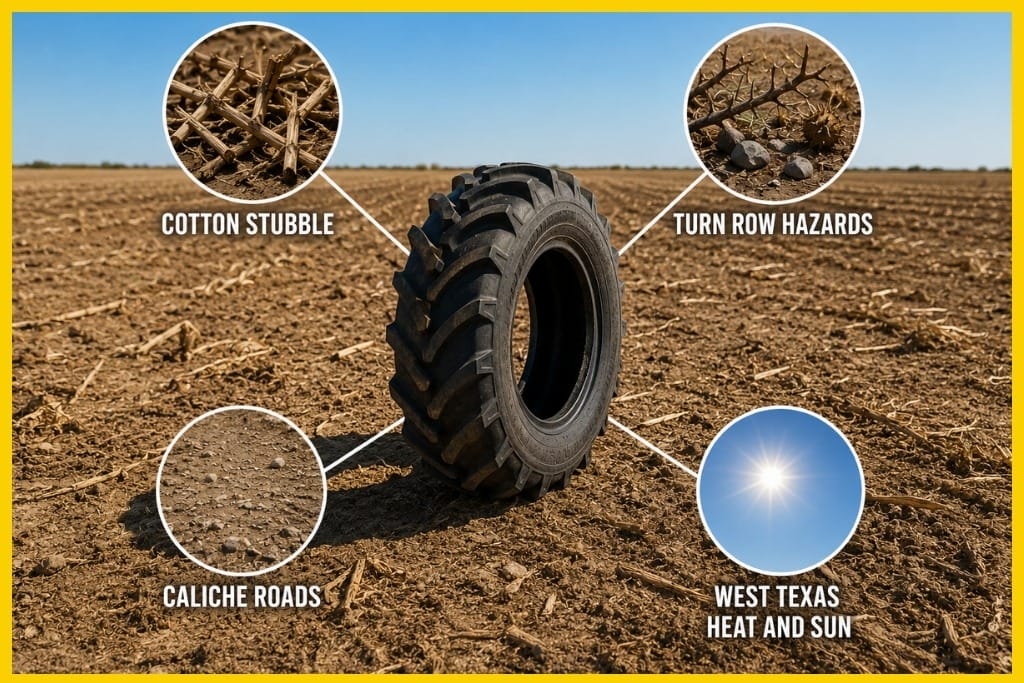
West Texas ground is hard on rubber in ways that go beyond weight and heat.
Cotton Stubble
Dry cotton stalks can repeatedly strike the tread and exposed areas of a tire as equipment moves through harvested fields. Existing cuts and weak areas deserve close attention because repeated contact can make them worse.
Turn Row Hazards
Sandburs, goatheads, mesquite thorns, rocks, and other debris along field edges can find vulnerable areas of a tire. Sidewalls deserve particular attention because damage there may be more serious than a repairable tread puncture.
Caliche Roads
Caliche access roads are abrasive. Equipment that regularly travels between fields may experience accelerated tread wear compared with equipment used primarily on soil.
West Texas Heat and Sun
Equipment that spends long periods outside faces sustained UV and heat exposure. Rubber can age even when a machine is not accumulating many operating hours.
You can’t remove these hazards from West Texas farming. You can inspect for their effects before a small issue becomes a field-side failure.
Understanding Farm Tire Tread Types
Agricultural tires come in different tread designs because different jobs demand different things from a tire. For most South Plains operations, three are worth knowing.
- R1 is the traditional agricultural traction tread, deep, widely spaced lugs built to grip soil and clear material. It’s the standard for general field work, planting, and cultivation in dry conditions.
- R1W uses a deeper lug than standard R1, which can help in wetter or irrigated ground and more demanding soil.
- R4 is a shallower, more closely spaced tread found on compact tractors, loaders, backhoes, and utility equipment that split time between dirt and hard surfaces. It won’t match an R1 or R1W for pure field traction.
For most row-crop field work on the South Plains, an R1 or R1W is the working answer. But tread pattern is only one part of the decision. When you shop for tires, load capacity, tire size, inflation pressure, road travel, and field conditions all have to work together.
Getting More Life From Farm Tires in West Texas
Farm tires are a significant equipment investment, so small maintenance habits and a regular tire inspection can pay off over several seasons.
Focus on these areas:
- Maintain appropriate inflation: Both excessive and insufficient pressure can affect traction, wear, heat buildup, and tire performance.
- Match tires to actual loads: Added implements, ballast, and changing equipment configurations can alter what the tire is being asked to carry.
- Inspect before long road travel: Speed, heat, and existing damage can be a bad combination when equipment has miles to cover.
- Do not ignore slow leaks: Repeatedly adding air without finding the cause can allow a repairable issue to become a more expensive problem.
- Watch for changing wear patterns: Uneven wear can point to inflation, alignment, load, or equipment setup issues that deserve attention.
The goal isn’t simply to make a tire last as long as possible. It is to get useful service life without sacrificing equipment performance, soil conditions, or reliability during the times you need the machine most.
Need Farm Tire Help in Lubbock? Talk to McWhorter’s
At McWhorter Tire and Service, we work with the vehicles and equipment that keep West Texas farms, ranches, and businesses moving, from farm tires to full auto repair services. We understand what South Plains fields, caliche roads, long transport distances, and extreme temperatures can demand from a tire.
If you are preparing equipment before harvest, replacing worn farm tires, or trying to determine which tire type fits your operation, talk with our team. We can help you consider the equipment, load, terrain, road travel, and operating conditions before you invest.
Lubbock Locations
- Frankford Avenue:
- Texas Avenue:
Out here, your equipment only earns when it is moving. The right tires and the right setup help keep it that way.