


Can You Replace Just One Tire on an AWD Vehicle?
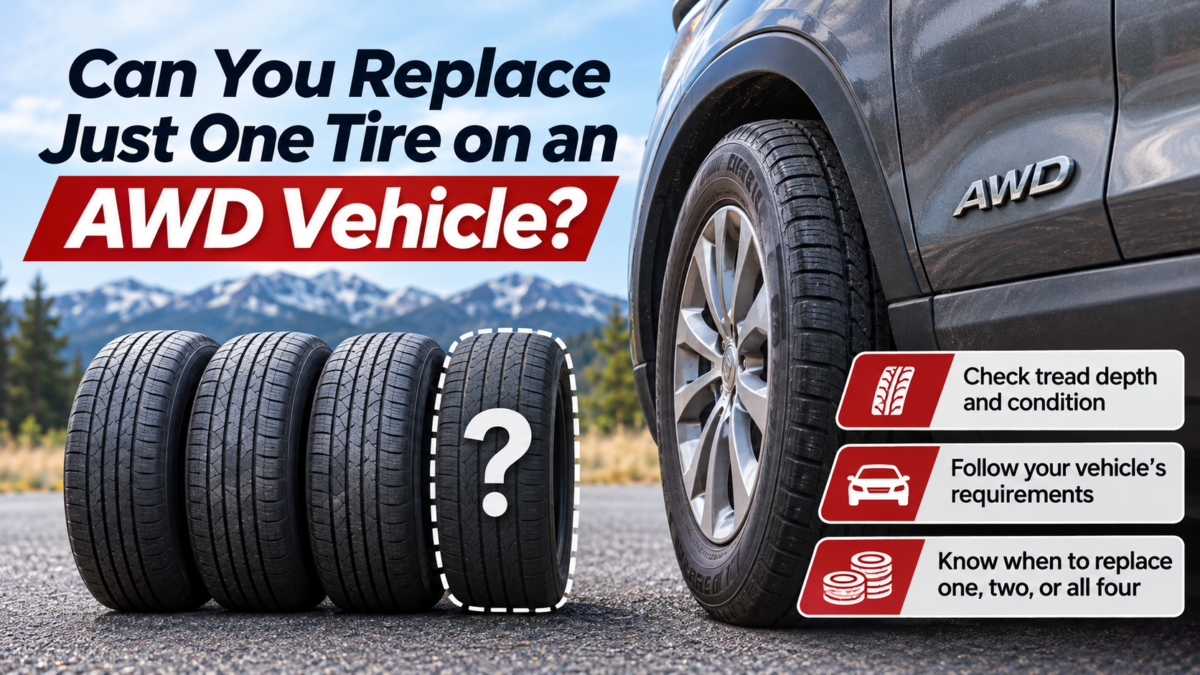
One damaged tire can turn into an unexpectedly complicated purchase when you drive an all-wheel-drive vehicle. You may have three tires that still look usable, yet hear that replacing only the damaged one could create a problem.
Sometimes a single replacement is possible. The decision depends on your vehicle manufacturer’s requirements, the condition of the remaining tires, and how closely the replacement matches them. AWD alone does not tell you how many tires to buy. Measurements and the vehicle’s specifications should drive that recommendation.
Why matching tires matters on AWD vehicles
As a tire wears, its tread becomes shallower and its overall circumference decreases. A smaller tire needs more revolutions to cover the same distance than a larger one.
AWD systems accommodate wheel-speed differences during normal driving, including turns. However, a persistent difference caused by mismatched tires can place extra stress on drivetrain components. The allowable variation depends on the vehicle.
That is why matching the size printed on the sidewall is only part of the decision. Tire model, construction, and remaining tread depth also matter. A brand-new tire and a heavily worn tire can carry the same size designation without being suitable partners for a particular AWD system.
Start by finding out whether the damaged tire is repairable
Before comparing replacement prices, have the damage evaluated. A qualifying puncture may be repairable, allowing you to keep the existing matched set.
A proper flat tire repair inspection requires removing the tire from the wheel so damage inside can be checked. For passenger and light truck tires, industry guidelines limit puncture repairs to the repairable tread area and injuries no larger than 1/4 inch. Shoulder or sidewall damage is outside that area. Tire condition, previous repairs, and the tire manufacturer’s policy can also rule out repair.
A small nail hole does not tell the whole story. Driving on a severely underinflated tire can damage it internally, even if the original puncture looks minor.
When a single replacement may be an option
Picture two different situations. In the first, a driver damages a tire shortly after purchasing a set. In the second, the puncture happens after years of use and uneven wear. Both vehicles have one damaged tire, but the replacement decisions may be very different.
The shop should check:
- The vehicle’s specific tire-matching requirements.
- The brand, model, size, and required ratings of the existing tires.
- Tread-depth measurements and condition across all four tires.
- Whether the proposed replacement meets the vehicle’s permitted variation.
If the other tires have very little wear and an appropriate matching tire is available, replacing one may be acceptable. If the replacement would fall outside the manufacturer’s limits, buying the same tire model does not solve the mismatch by itself.
Ask to see the measurements and the relevant vehicle guidance. Those details make the recommendation easier to understand than a blanket statement that AWD always requires four new tires.
Why replacing two tires is not always the compromise
Replacing a pair can sound like a reasonable middle ground. On an AWD vehicle, though, two new tires can still differ too much from the two older tires.
General advice about where to install a new pair does not override AWD matching requirements. Before choosing a pair, the shop needs to confirm that the resulting four-tire combination is acceptable for your vehicle.
Some vehicles also have factory-specified differences between front and rear tire sizes. Preserve that approved arrangement. Do not substitute a generic rule that every vehicle needs identical sizes at all four corners.
If a full set is needed, choose for the driving you actually do
Replacing four tires is a larger expense, so use the decision to reassess your needs. A Colorado driver who regularly heads into the mountains may prioritize different seasonal performance than a driver making mostly highway trips around Wichita or Lubbock.
Keep two decisions separate: which tire category fits your driving, and which approved set fits your vehicle. If you move to a different category, plan for a compatible set rather than adding one different tire to the existing group.
When comparing options, consider the tire size, ratings, and driving needs that matter when buying tires. Matching requirements come first, followed by the performance priorities that matter on your routes.
Questions to ask before approving the work
Request an explanation that answers three things: whether repair was possible, what the remaining tires measured, and which vehicle requirement determines the replacement recommendation.
If uneven wear contributed to the decision, ask what needs checking before the new tires go into service. Correct inflation, an appropriate rotation schedule, and attention to alignment or suspension problems can help keep the next set wearing more evenly. Rotation will not undo a mismatch that already exceeds the vehicle’s limits.
AWD tire replacement FAQs
Is there one tread-depth difference that is safe for every AWD vehicle?
No. Do not apply a number from another vehicle or an online discussion to yours. The shop should use the requirements for your particular model and tire setup.
Can I use the temporary spare on my AWD vehicle?
Follow the owner’s manual for whether it is permitted, where it must be installed, and its speed and distance restrictions. A temporary spare is not a long-term substitute for a matching tire.
Will a road-hazard warranty pay for all four tires?
Do not assume so. Coverage depends on the written plan, eligibility, and exclusions. Ask how it handles one damaged tire when the vehicle’s matching requirements affect the other three.
What should I have ready when calling for a quote?
Provide the year, make, model, AWD configuration, tire size, and current tire brand and model. Mention any staggered fitment. A final recommendation may still require inspecting and measuring the tires.
Get a recommendation based on your vehicle
Contact your nearest Nebraskaland, Kansasland, Coloradoland, or McWhorter’s Tire and Service shop through our tire and service location directory. Explain that you have an AWD vehicle with one damaged tire, and ask about an inspection before choosing a replacement quantity.